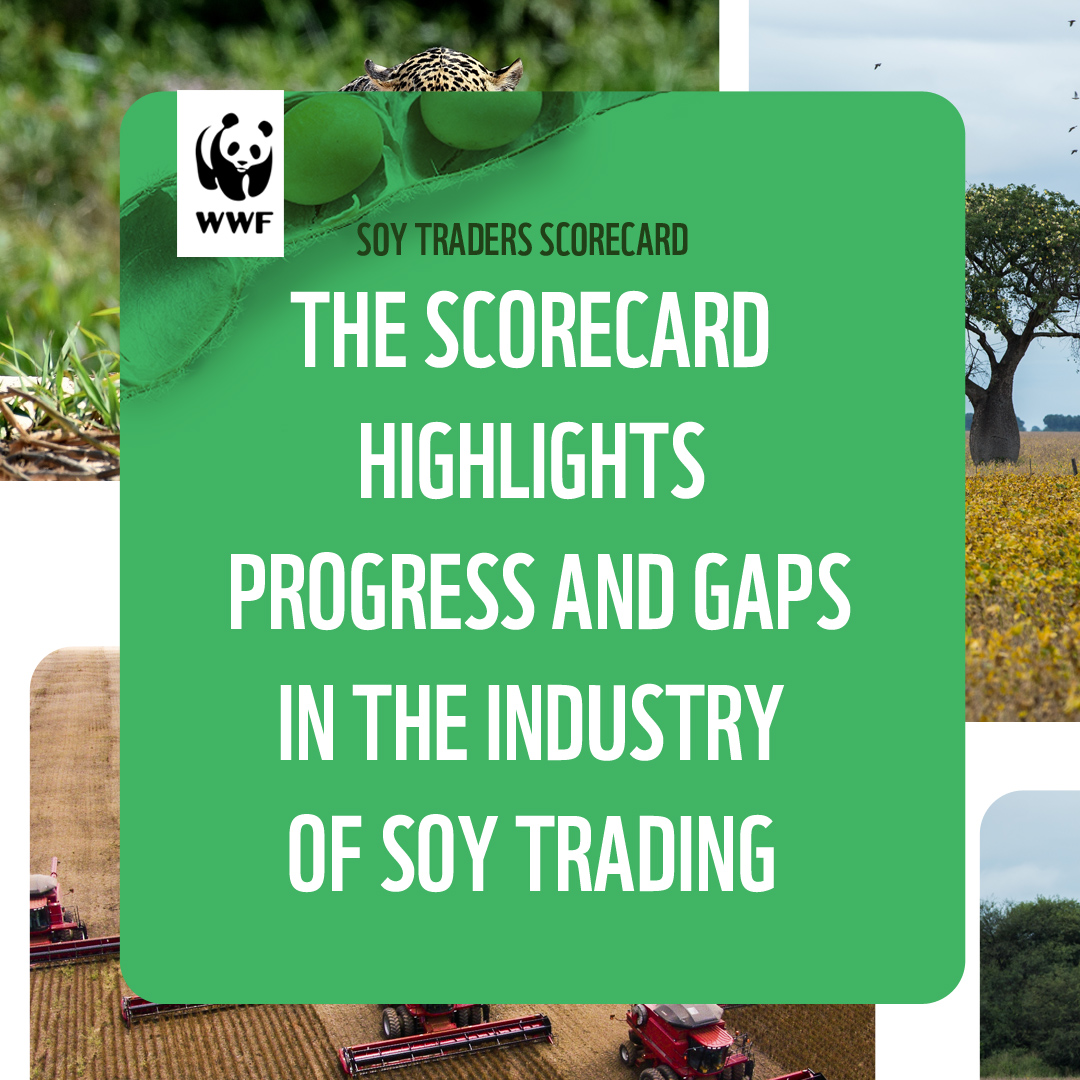
Global soy traders are not doing enough to prevent the devastating impacts of soy production on forests and
other crucial ecosystems, nor do they adequately tackle human rights abuses in soy supply chains, according
to a new Scorecard launched today by WWF in collaboration with Global Canopy.
This first-of-its-kind Scorecard measures the commitments and actions taken by twenty-two of the world’s
biggest soy traders to address critical environmental and social issues occuring in their supply chains.
Of the nine traders who responded to the survey (representing 52% of global soy exports), the highest total
score obtained by a company was only 52.5%. This indicates that there is substantial room for progress
across all major companies. Furthermore, existing commitments to deforestation- and/or conversion-free soy
are weak and need to be strengthened. The Scorecard finds commitments lack clear cut-off dates, not applied
equally across full supply chains nor to all ecosystems at risk, and target dates do not reflect the urgency of
the issue.
The companies were assessed on the strength and implementation of their deforestation- and conversion-free
commitments for their soy supply chains. They were selected based on their potential exposure to these risks,
measured by estimated volumes of soy exported from key producing countries (Brazil, US, Argentina, and
Paraguay, which together represented 84% of global soy production in 2020), and estimations of
deforestation risk linked to soy from some these areas by trase.earth. Most of the 22 companies are
headquartered in the US (six), Japan (four), Brazil (three) and Argentina (three), with the remaining
companies headquartered in Europe (France, Liechtenstein, Luxembourg, Switzerland), China and South
Korea.
Millions of hectares of critical habitat in the Cerrado, the Atlantic Forest, the Gran Chaco, and Chiquitania in South America, and North America’s Great Plains have been ploughed up for soy fields. According to WWF’s
2020 Deforestation Fronts report, the Cerrado and the Gran Chaco had the highest average annual
deforestation in the period 2004-2017, largely driven by large- and medium-size farmers accompanied by
expansion of logistic and storage and crushing facilities. A growing demand for protein for animal feed is
driving this expansion, increasingly also encroaching on African Savannah and Central-Asian native
grasslands, endangering wildlife, nature, people, and the climate. Agricultural expansion on native vegetation
is also leading to increased pressure on indigenous peoples and local communities, who are often evicted
from the land, in turn losing their livelihood. WWF’s recent report Stepping up? The continuing impact of EU
consumption on nature worldwide showed that soy has the highest associated imported deforestation
footprint for the EU, over other soft commodities.
“Soy is one of the largest drivers of global deforestation and conversion as it's grown in critical natural
ecosystems that provide important wildlife habitats and have an essential role to play in climate change
mitigation. To ensure zero deforestation and conversion, and eliminate human rights abuses, all soy traders,
buyers, and financiers must rapidly turn their words into action bringing commitments into implementation
across the full supply chain" says Cristianne Close, WWF Markets Practice lead at WWF International.
Emma Thomson, Forest 500 project lead at Global Canopy says: “Soy traders still have work to do to make
their deforestation and conversion commitments a reality. Commitments rarely cover all of the areas at risk, or
include the full supply chain. We know that forests and valuable ecosystems continue to be cleared for soy.
Traders need to improve the transparency of their supply chains and close the market for soy from deforested
or converted land"
WWF and Global Canopy urgently call on agribusinesses to scale up their commitments and implement
strong action plans that are aligned with Accountability Framework initiative guidance (AFi), while increasing
transparency in reporting on risk exposure and progress toward commitments over time. More specifically:
Soy traders urgently need to commit to zero conversion and to respect human rights across their
supply chains, with a 2020 or earlier cutoff date, and accelerate delivery against this commitment;
Soy buyers need to make their own soy supply chains free of deforestation, conversion, and human
rights abuses, and require their suppliers to do the same across their entire operations;
Financial institutions should require their clients to commit to a conversion-free policy with a 2020
or earlier cutoff date, to respecting human rights, and set ambitious time-bound action plans to
achieve this commitment;
Policymakers need to adopt and enforce binding legislation to ensure that all agricultural commodity
supply chains are free of deforestation, conversion and human rights abuses.
More details on the scorecard findings, methodology and recommendations are available on
soyscorecard.panda.org/traders/